Table of Contents
- What the Standards Fix — and What They Leave to You
- The Document Set to Request Before Shortlisting
- CMA, CNAS, ISO/IEC 17025 and the ILAC MRA Are Four Different Things
- Seven Checks on Any Third-Party Test Report
- Where "Purification Efficiency" Hides a Method Mismatch
- Why Ozone Is the Red Line
- Terminology: Deacidification Is Not Your Machine
- Acceptance: Checking the Numbers on Site
- Supplier Due-Diligence Checklist
Archive and museum procurement teams rarely get burned by a weak compressor. They get burned by a test report that looks official and proves nothing: no capability scope behind it, no authorized signatory, a subcontracted test the buyer never approved, or a purifier that meets its "purification efficiency" number while quietly becoming an ozone source inside a storage room.
This guide sets out what to demand from an archive dehumidifier supplier, how to tell a genuine third-party test report from a decorative PDF, and why ozone is the one specification that has to be treated as a red line rather than a selling point. Every checkpoint below is written so you can lift it into a specification as an objective pass/fail condition.
1. What the Standards Fix — and What They Leave to You
Choosing a relative-humidity set point for a repository is the easy part. Proving that a supplier's performance numbers come from a named method, a competent laboratory and an accreditation scope that covers that method is the hard part.
Start by separating what each reference document actually fixes from what it leaves to the buyer:
| Document | What it fixes | What remains open |
|---|---|---|
| ISO 11799:2024 (3rd ed.) | Repository characteristics: siting, construction, renovation, and the equipment used within and around the building. Clause 8 requires environmental monitoring (8.2.3 sample rates, 8.2.4 retention and analysis); 6.2.7 covers offgassing of construction materials. | Climatic conditions sit in Annex B (informative), not in the normative body. The 2015 edition carried an informative annex on air pollutants; the 2024 contents show no equivalent. |
| EN 16893:2018 | Storage buildings for heritage collections: environmental strategy (4.3), monitoring (4.4), air quality (5.4), mechanical control (5.5). | Temperature and RH risk tables are informative (Annexes B and C). Its normative references contain one air-filtration standard, EN ISO 16890-1, for particulate filters — none for gas-phase. |
| BS 4971:2017 | Archive and library collection care; supersedes PD 5454:2012. Reported by three secondary sources (the standard is paywalled) as 13–23 °C, annual average below 18 °C, 35–60% RH for mixed archives. | No equipment performance figures at all. |
| NARA 1571 (effective 17 January 2023) | Temperature and RH bands by storage type; fluctuation between limits is acceptable and slow seasonal drift is permitted. Post-filtration maxima (Supplement 2, Table 2): SO2 5 µg/m³ (1.9 ppb), NO2 5 µg/m³ (2.6 ppb), ozone 5 µg/m³ (2.5 ppb), acetic acid 250 µg/m³ (100 ppb), with tighter limits inside microclimates. | Which model delivers them. |
| CCI | Above 75% RH counts as damp; mold onset near 100 days at 70% RH, 10 days at 80% RH, 2 days at 90–100% RH. Fluctuation risk by swing size; ASHRAE-derived control classes AA–D; pollutant targets of 10 / 1 / 0.1 µg/m³ for ozone, SO2 and NO2 at 1-, 10- and 100-year horizons. | Device design. |
These documents specify outcomes, so a claim is only as good as its test method — and because the targets are informative, write your acceptance criteria into the contract rather than quoting the standard at a supplier.
2. The Document Set to Request Before Shortlisting
Ask for these five items from every supplier you shortlist. A summary sheet is not a substitute for any of them, and a missing item is a finding in itself, not a scheduling detail.
| Document | What it establishes | Usual failure mode |
|---|---|---|
| Full test report, not a summary sheet | Method, sample identity, conditions, results | A "certificate of conformity" with no method named |
| Accreditation certificate plus scope annex and the method statement | Which methods the laboratory is accredited for, and to which edition | Accreditation valid, test item out of scope |
| Downstream ozone measurement from the same run | That purification does not add the pollutant being removed | Omitted entirely |
| Calibration certificates, sample and serial-number linkage | Traceable values, and that the tested unit is the unit shipped | Instrument list with no calibration status; a prototype test sold as a production claim |
| Subcontracting disclosure and witness declarations | Who performed each test item, and whether your staff operated the unit | Undisclosed third-party testing; a witnessed test presented as an accredited result |
3. CMA, CNAS, ISO/IEC 17025 and the ILAC MRA Are Four Different Things
Foreign buyers often treat "Chinese test report" as a single category. It is several different things, and the distinction is the first filter to apply.
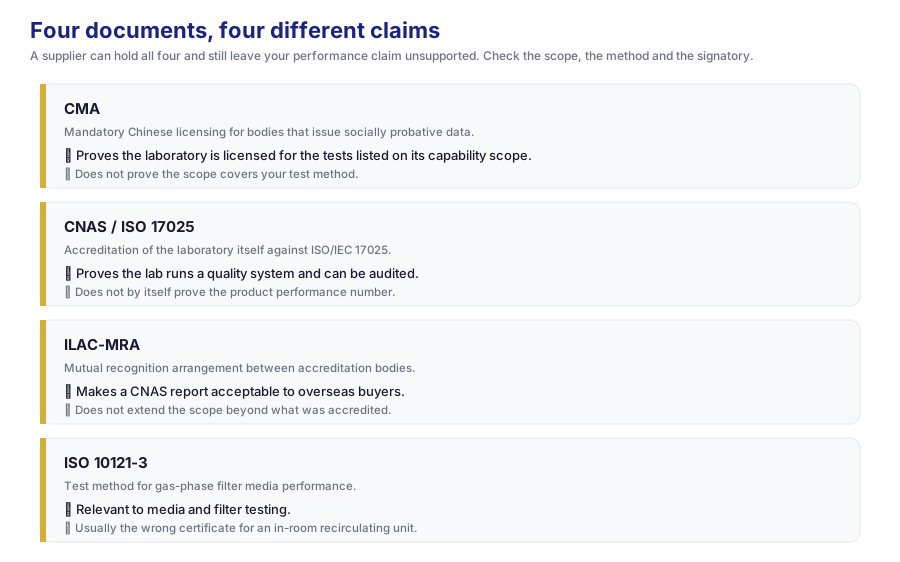
CMA (检验检测机构资质认定) is a mandatory evaluation and licensing scheme. Market-regulation authorities assess whether a body that issues data and results with probative effect to society meets statutory basic conditions and technical capability. Its legal basis is the Metrology Law and the Certification and Accreditation Regulation. A CMA body may only issue data and results within the capability scope listed on its certificate, must mark reports issued with probative effect to society with the CMA symbol, and holds the certificate for six years.
CNAS is a different animal: it is China's national accreditation body, and it accredits laboratories against ISO/IEC 17025, the standard used to accredit testing and calibration laboratories (ISO/IEC 17011 governs the accreditation bodies themselves). CNAS-CL01 is the identical national adoption of that standard, and CNAS-EL-13:2019 is the CNAS official explanation of the requirements for test reports and calibration certificates issued by accredited laboratories — useful when you need to argue about report content with a supplier.
The ILAC MRA, not the CMA mark, is how Chinese results gain international acceptance. ILAC became a formal cooperation in 1996; the ILAC MRA was signed in 2000 and took effect for calibration and testing laboratories on 31 January 2001, and was extended to inspection bodies in October 2012. CNAS states that it is a full member of IAF, ILAC, APLAC and PAC and a signatory to all of their mutual recognition arrangements, so China's accreditation results feed into the international mutual-recognition system.
Use it in three steps: identify the laboratory named on the report; establish its accreditation status and, critically, the scope of that accreditation rather than the existence of a certificate; then confirm the specific test method sits inside that scope and that the accreditation body is itself a signatory to the relevant arrangement. Under ILAC-P8:11/2023 §5.1, only reports carrying the accreditation symbol or a text reference to accreditation benefit fully from MRA recognition; under §7.1–7.2, results outside the accredited scope must be disclaimed. A report bearing only the CMA mark should therefore not be presented as internationally recognized accreditation.
What a report has to contain
ISO/IEC 17025:2017 clause 7.8.2.1 requires the laboratory name, the work location, the method, item identification, dates, results with units, deviations and the authorizing person; 7.8.3.1 adds test conditions, any statement of conformity and measurement uncertainty.
Four CNAS practice checks decide whether a report actually covers your machine:
- §2.1 a) — the report must describe the tested sample. If several models are listed against one prototype, it must say which was tested and include model-verification results.
- §2.1 b) — off-site testing needs the detailed address, not "client site".
- §2.1 c) — a witnessed test must be marked as such and must not carry the accreditation symbol; it is outside CNAS scope.
- §2.1 d) and §2.2 — quoted data must be annotated; client-supplied data identified and disclaimed where it can affect validity.
The scope check is where most optimistic reports fail. Accreditation is granted per method, per parameter, per standard revision. A laboratory accredited for acoustic testing is not thereby accredited for gas-phase air cleaning media.
4. Seven Checks on Any Third-Party Test Report
Work through these in order. Any one of them can invalidate an otherwise impressive document.
| # | What to check | What the rules actually require |
|---|---|---|
| 1 | CMA certificate validity | CMA certificates are valid for 6 years. Check the certificate number and status against the issuing authority's public record — licensed bodies and certificate status must be published on the authority's official website. |
| 2 | CMA mark and signatory | Reports issued with probative effect to society must carry the CMA symbol (the graphic formed from the initials of "China Inspection Body and Laboratory Mandatory Approval" plus the qualification-accreditation certificate number). A valid report must carry the body's official seal or testing-dedicated seal and be signed by an authorized signatory acting within that person's technical competence. |
| 3 | Capability scope | Data and results may only be issued within the capability scope listed on the certificate. Operating outside the certified scope is a sanctionable violation in its own right. |
| 4 | Stated technical basis | The report must state its standard and technical basis explicitly. "Tested to international standards" is not a technical basis. |
| 5 | Subcontracted items | Subcontracted items must go to a body with the corresponding conditions and capability, with the client's prior consent for both the item and the intended subcontractor, and the report must note the subcontracted item and the subcontractor. Undisclosed outsourcing is a defect you can reject on. |
| 6 | Raw records retention | Raw records and reports must be archived and retained for not less than 6 years. Ask for the retention policy in writing; it is the mechanism by which a report can later be reconstructed or challenged. |
| 7 | Method fit | Match the test method to the product architecture — see the next section. A correct report of the wrong test is still the wrong evidence. |
The two statutory failure categories worth naming in a contract
China's day-to-day conduct rules define two escalating categories, and both definitions are worth lifting into your purchase conditions.
- An "unfaithful" report covers sampling, marking, transfer, preparation, storage or disposal not performed per standard; use of unverified or uncalibrated instruments; breach of mandatory testing methods; or failure to store raw data and reports per standard.
- A "false" report is more serious: no testing performed at all; forged or altered raw data or records; omission, reduction or alteration of items that should have been tested or of key test conditions; swapping samples or changing their state before testing; or forging the body's seal, the authorized signatory's signature or the issue date.
Penalties were raised: under the 2025 revision (SAMR Order 101, dated 18 March 2025), fines run up to CNY 50,000 for unfaithful reports and up to CNY 100,000 for false reports, against up to CNY 30,000 under the 2021 text. Issuing probative data or results without CMA, operating outside the certified capability scope, failing to mark the CMA symbol, and using expired, withdrawn or revoked certificates or symbols each carry sanctions of up to CNY 30,000.
These fines are small. The real value to a buyer is that these failure modes are legally defined, so you can write them into a specification as objective rejection criteria rather than arguing about intent.
5. Where "Purification Efficiency" Hides a Method Mismatch
Gas-phase filtration testing is where equipment suppliers and test laboratories most often talk past each other.
ISO 10121-3:2022, published October 2022, establishes a classification system for gas-phase air cleaning devices and media supplying single-pass outdoor air to general ventilation systems, using four reference pollutants — ozone, sulfur dioxide, nitrogen dioxide and toluene — and three duty levels per pollutant.
Read the exclusion carefully: that document does not apply to devices in recirculation applications and/or dealing with pollution from indoor sources, nor to pharmaceutical, microelectronic, nuclear, homeland security and military applications.
A standalone in-room archive dehumidifier-purifier is, by construction, a recirculating device working largely on indoor-sourced pollutants. So an ISO 10121-3 classification may be a legitimate statement about a device's media while still not being the standard that governs its in-room performance. Ask the supplier two separate questions: which method was used, and what does that method's scope actually cover.
The evidence chain that fits a room-scale unit is level by level:
- Media level — ISO 10121-1:2014 or ASHRAE 145.1-2015, which test the media. ISO 10121-1 warns that its elevated challenge concentrations compare like configurations rather than predicting installed performance.
- Device level — ISO 10121-2:2013 or ASHRAE 145.2-2011, which estimate the performance of a full-size gas filtration device. A standalone supplied cabinet and a central filter bank are both evidenced here.
- Field level — corrosion monitoring or periodic sampling after commissioning. ASHRAE does not certify or assure product performance, so "tested per ASHRAE 145.2" is a laboratory rating, never a certification.
- The built-environment gap — EN 16893:2018 references only EN ISO 16890-1, so gas-phase performance has no normative test method behind it. Name the method in the specification.
Require the challenge concentration, airflow, residence time (empty-bed contact time, ignoring media volume, which may fill 40% of bed volume) and pressure drop alongside any efficiency figure. A claim without them is not reproducible, and peak efficiency at zero media age says nothing about service life. One aggregate figure such as "purification efficiency 99.9%", with no pollutant, challenge concentration, airflow or residence time attached, cannot be compared with a 5 µg/m³ limit and must not be the basis of acceptance.
If you want a pollutant number, use a pollutant number
The most directly usable gaseous thresholds in the public record are NARA 1571 Supplement 2, Table 2 (effective 17 January 2023), giving maximum concentrations after air filtration for holdings storage rooms: sulfur dioxide 5 µg/m³ (1.9 ppb); nitrogen dioxide 5 µg/m³ (2.6 ppb); ozone 5 µg/m³ (2.5 ppb); acetic acid 250 µg/m³ (100 ppb). Exhibit cases and microclimates carry tighter limits: sulfur dioxide 2.7 µg/m³ (1 ppb); formaldehyde 5.0 µg/m³ (4.0 ppb); acetic acid 10.0 µg/m³ (4.0 ppb).
For corrosion-based acceptance, the ISA S71.04 method is used commercially with silver and copper film thickness over 30 days. One published supplier classification places S1 (<40 Å) / C1 (<90 Å) as ideal archival air quality, S2 (<100 Å) / C2 (<150 Å) as desired for museums and libraries, S3 (<200 Å) / C3 (<250 Å) as clean, S4 (<300 Å) / C4 (<350 Å) as slightly contaminated with corrective action indicated, and S5/C5 as polluted. Treat the exact Å values as indicative; the method is the transferable part.
NARA 1571 also imposes a system-design requirement your supplier should map onto: gas-phase and particulate filtration are required in any air handling unit serving holdings storage spaces, both return air and make-up air must be filtered, and the gas-phase filter must sit before the final particulate filter, with access to detectors upstream and downstream to evaluate performance. The clause permits combining chemisorption, adsorption and catalytic processes.
6. Why Ozone Is the Red Line
Ozone appears in those tables for one reason: it is a contaminant to be removed, and it is also a pollutant the standards explicitly reference in gas-phase filter testing. It is not a conservation tool.
NARA 1571 Supplement 2, Table 2 caps ozone at 5 µg/m³ (2.5 ppb) in holdings storage rooms after filtration. CCI gives 10 / 1 / 0.1 µg/m³ for 1-, 10- and 100-year preservation targets, and ISO 10121-3:2022 uses ozone as one of its four reference pollutants. A technology that generates ozone as a by-product adds a regulated pollutant while claiming to remove pollutants.
Three consequences for specification:
- Removal is the requirement; generation is a defect. Ask for ozone performance as an inlet/outlet concentration pair against the 5 µg/m³ (2.5 ppb) benchmark, not as a single removal percentage.
- Know the mechanism. The NARA filtration clause names chemisorption, adsorption and catalytic processes. Any technology whose operating principle produces ozone as an intermediate has to be justified with downstream measurement: the storage room is an occupied, collection-filled space, not a duct.
- Corrosion control is the end use. AAF's museum literature targets hydrogen sulfide, nitrogen dioxide, sulfur dioxide, formaldehyde, ozone, formic acid, acetic acid, carbonyl sulfide and halogens, against susceptible materials including metals, marble and limestone, photographs, paper, organic textiles, glass and manuscripts. Camfil traces ozone in these spaces to vehicle exhaust, combustion and flash photography. Your acceptance criterion is a measured indoor concentration, not a technology name.
Ask for the downstream ozone concentration from the same run as the removal claim, with the detection method and limit named, and ask what it becomes at your airflow and at end of media life.
7. Terminology: Deacidification Is Not Your Machine
CCI defines deacidification as a paper and book treatment: adding alkaline compounds to block acids already in the object. Air-side acid removal is instead called gas-phase air cleaning (ISO 10121, ASHRAE 145), molecular filtration, or corrosion control.
A datasheet calling a room-scale machine a "deacidification unit" has both the vocabulary and the test method wrong — and a supplier using the wrong vocabulary is usually also quoting the wrong test. When you see the term applied to equipment, treat it as a signal to ask which standard the number came from.
8. Acceptance: Checking the Numbers on Site
NARA 1571 is a usable commissioning pattern anywhere. It requires gas-phase and particulate filtration in any air handling unit serving storage spaces, on both return and make-up air, with the gas-phase filter before the final particulate filter and particulate filtration at MERV 14 or greater per ASHRAE 52.2; new construction must run HVAC and filtration continuously for four weeks before holdings are moved in. Dehumidification by reheat or desiccant, clean-steam humidification downstream of the filters, and a failsafe humidistat must be designed in; dedicated HVAC may be stand-alone units or fully integrated.
The protocol that follows:
- Baseline before installation at fixed points, using the instrument you will use again — otherwise there is no removal figure, only an anecdote.
- Repeat after commissioning at the same points with the same instrument, recording the operating envelope at the same moment: airflow, residence time or face velocity, pressure drop, media age. Removal efficiency is a function of those, not a fixed property.
- Verify ozone, and treat corrosion-coupon classifications as evidence rather than certification: the AAF and Purafil tables are manufacturer schemes, not consensus standards.
- Make monitoring a deliverable. ISO 11799:2024 clause 8 requires monitoring with sample rates, data retention and trend analysis; because CCI/ASHRAE classes and NARA bands are band-based, your evidence is a time series, not a spot reading. Specify RS485/Modbus export, logging interval and retention period.
9. Supplier Due-Diligence Checklist
Ask for all twelve items before signing. Mark any "we'll send it later" as an open item, not a yes.
- CMA certificate with number, validity dates and the full capability scope annex.
- CMA certificate status verified against the issuing authority's published record (certificates are valid 6 years).
- CNAS accreditation certificate and scope schedule for the named laboratory, with method-level entries.
- The test report itself, showing the CMA symbol, the body's official or testing-dedicated seal, and the signature of an authorized signatory within their technical competence.
- A written statement of the report's technical basis — standard number, revision and method.
- A subcontracting declaration: whether anything was outsourced, to whom, on what item, and the evidence of your prior consent.
- Raw-record retention policy confirming retention of raw records and reports for not less than 6 years.
- Instrument calibration and verification records for the instruments used on your test.
- Method-to-application statement: for any ISO 10121-3 result, confirm in writing that it covers single-pass outdoor air and not recirculating, indoor-source applications.
- Ozone data as inlet/outlet figures against the 5 µg/m³ (2.5 ppb) NARA threshold, plus a statement of whether the purification mechanism can generate ozone.
- Particulate filtration rating and filter sequence, including where the gas-phase stage sits relative to the final particulate filter, and how performance is monitored upstream and downstream.
- Corrosion-monitoring acceptance test (for example ISA S71.04 coupons exposed 30 days) with pre-agreed pass/fail bands.
If a supplier cannot produce items 1–7 without delay, that is itself the finding. Reports are supposed to be traceable to a licensed, scoped, retained record — if the trail stops at a beautifully formatted PDF, the number on it is not evidence.
Ask for the Documentation, Not Just the Brochure
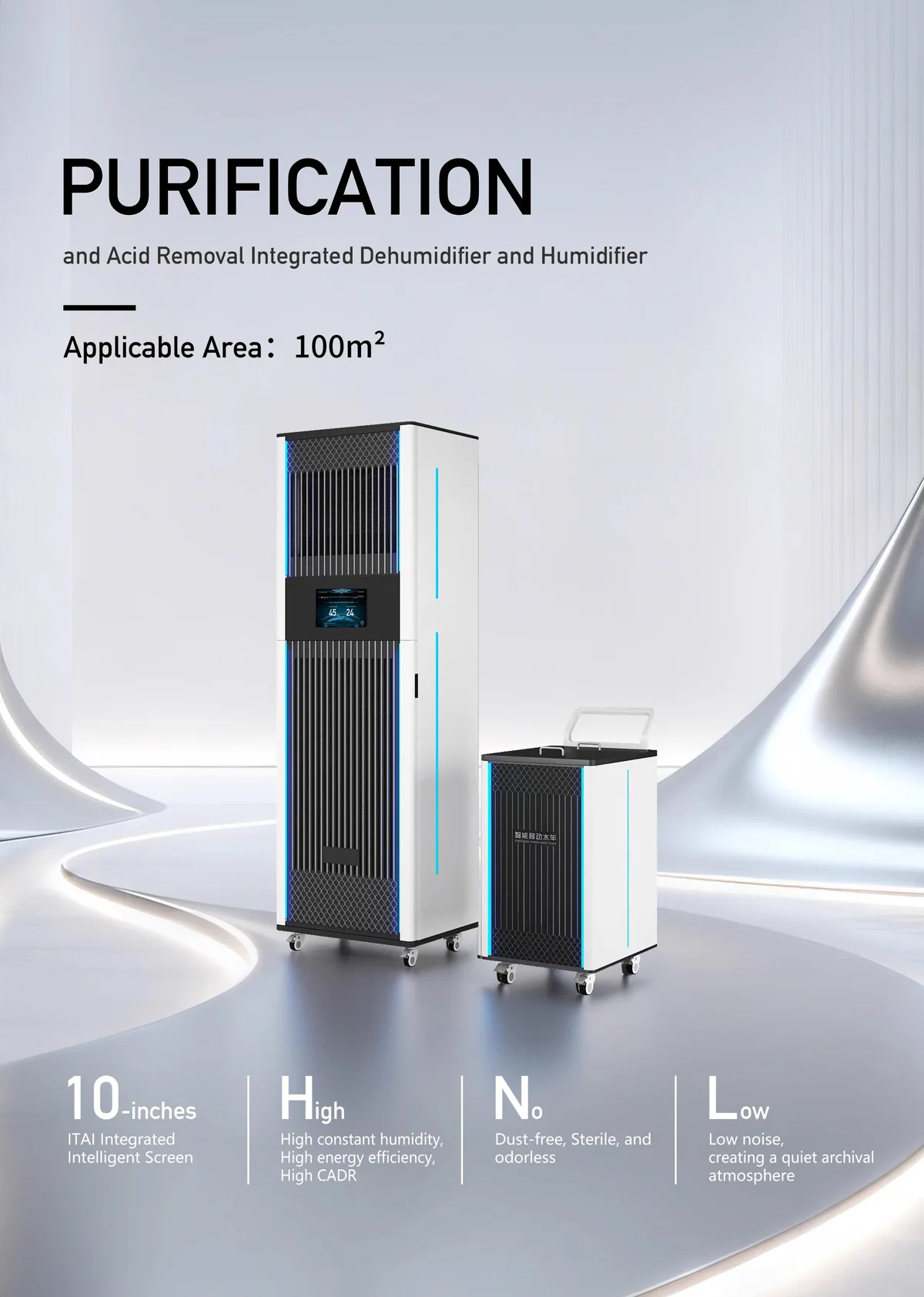
The CJS-HP100B is a supplied dehumidification, gas-phase filtration and humidification unit for archive, library and museum rooms, marked at 100 m² applicable area. Ask for its documentation pack: the named test method behind each performance figure, the laboratory and accreditation scope attached to it, ozone data as an inlet/outlet pair, and the RS485/Modbus register map for your monitoring records.
View CJS-HP100B Specifications →Visit our online store for pricing →
Questions? alex@syprointl.com | +86 177 1055 7225
By environment: Archive & vault · Museum storage · Library special collections · Film & AV archive