
Table of Contents
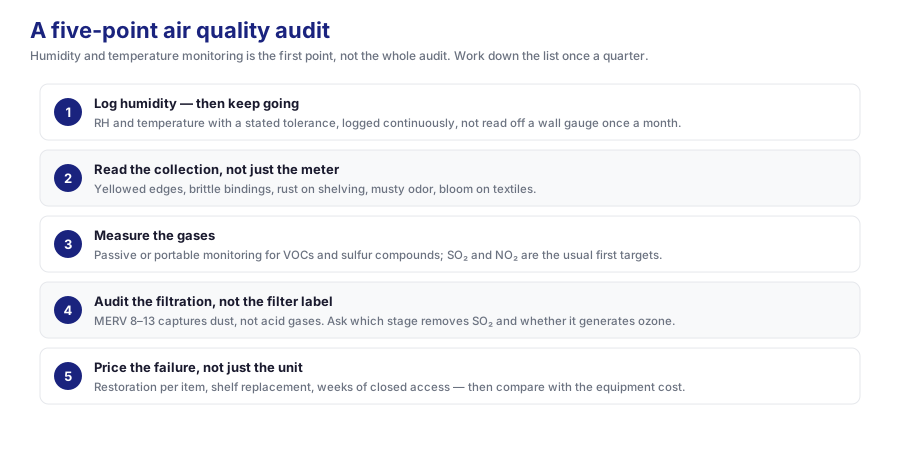
You track temperature and humidity. But what about airborne acids? Here's a practical facility audit.
1. Check Your Humidity — But Don't Stop There
Standard preservation guidelines recommend 40-60% RH at 18-22°C. If you're within this range, good. But humidity control alone doesn't stop acid-driven degradation. A dehumidifier pulls out moisture but leaves corrosive gases circulating. If your collections show yellowing, brittleness, or musty odors despite stable humidity — you have an acid problem.
2. Look for These Visual Signs
Walk through your storage area: yellowing paper edges, brittle document bindings, rust on metal shelving, musty odors, mold spots on textiles. Any of these suggests acidic air is at work.
3. Test Your Air
A portable air quality monitor measuring VOCs and sulfur compounds costs under $200. If VOC readings exceed 500 ppb or SO₂ exceeds 20 ppb — you need active acid filtration.
4. Audit Your HVAC Filtration
Standard HVAC filters rated MERV 8-13 capture dust, not acidic gases. SO₂ and NOₓ pass right through. You need chemical filtration — activated carbon or alkaline media — to neutralize acids.
5. Calculate What Poor Air Is Costing You
Document restoration: $50-500 per item. Metal shelf replacement: thousands. Mold remediation: shut down for weeks. A professional acid-removal dehumidifier costs a fraction of one major restoration event. The math is straightforward.
If you're only monitoring temperature and humidity, you're missing the silent threat. Add acid monitoring to your facility checklist this quarter.
Frequently Asked Questions
What humidity range do standard preservation guidelines recommend?
Standard preservation guidelines recommend 40-60% RH at 18-22°C.
Is stable humidity enough to stop degradation?
No. Humidity control alone doesn't stop acid-driven degradation: a dehumidifier pulls out moisture but leaves corrosive gases circulating. If your collections show yellowing, brittleness, or musty odors despite stable humidity, you have an acid problem.
What visual signs suggest acidic air is at work?
Yellowing paper edges, brittle document bindings, rust on metal shelving, musty odors, and mold spots on textiles.
What air readings mean you need active acid filtration?
A portable air quality monitor measuring VOCs and sulfur compounds costs under $200. If VOC readings exceed 500 ppb or SO₂ exceeds 20 ppb, you need active acid filtration.
Why are standard HVAC filters not enough?
Standard HVAC filters rated MERV 8-13 capture dust, not acidic gases, and SO₂ and NOₓ pass right through. You need chemical filtration — activated carbon or alkaline media — to neutralize acids.
What is poor air quality costing the facility?
Document restoration runs $50-500 per item, metal shelf replacement runs into thousands, and mold remediation can shut a facility down for weeks. A professional acid-removal dehumidifier costs a fraction of one major restoration event. The math is straightforward.
Add Acid Monitoring to Your Facility Checklist
If you're only monitoring temperature and humidity, you're missing the silent threat. Send us your room parameters and current readings and we will map them against the five-point audit above.
Get a Custom Climate Assessment →Questions? alex@syprointl.com | +86 177 1055 7225
By environment: Archive & vault · Museum storage · Library special collections · Film & AV archive