
Table of Contents
- Start From the Measurable Target, Not the Equipment
- What the Standards Require — and Where They Stay Quiet
- Where Standards and Vendor Literature Assume a Central Plant
- The Retrofit Case for a Standalone Cabinet
- Selection Matrix: Central AHU vs Standalone Cabinet
- Cost Structure: What the Money Actually Buys
- The Standards Gap You Must Design Around
- What to Ask a Supplier, and How to Verify It
- Where This Leaves a Retrofit
You have an existing archive, library or museum store, a gas-phase pollutant target you must meet, and no obvious place to put a molecular filter bank. The two architectures available — gas-phase filtration built into the central air handling unit (AHU), or a self-contained recirculating cabinet standing in the room — are both legitimate and both appear in the conservation literature. They fail in different ways, and the choice usually turns on the building rather than on the media.
Most published guidance assumes a central plant to hang filtration on. In a retrofit you often do not have one: the repository is a listed building, a basement with no duct riser, or a leased floor where the landlord will not allow roof plant. This article compares the two architectures on the criteria that actually decide a retrofit, and is explicit about where the standards help you and where they leave you to write the specification yourself.
1. Start From the Measurable Target, Not the Equipment
NARA 1571 (US National Archives, Archival Storage Standards, effective 17 January 2023, cancelling the 2002 version) is the most explicit document in this field. At clause 1571.4 h it requires that “gas-phase and particulate filtration systems are required in any air handling unit serving the holdings storage spaces.” Both return air and make-up air must be filtered; the gas-phase filter sits before the final particulate filter; filters must be easily accessible; and detectors must be reachable upstream and downstream of them. The particulate stage must reach MERV 14 or greater under ASHRAE 52.2, with a pressure-drop measurement system to decide when filters need changing. New construction must also run the HVAC with filtration continuously for at least four weeks before holdings are moved in.
Supplement 2, Table 2 fixes the acceptance thresholds — maxima after air filtration: sulfur dioxide 5 µg/m³ (1.9 ppb), nitrogen dioxide 5 µg/m³ (2.6 ppb), ozone 5 µg/m³ (2.5 ppb), acetic acid 250 µg/m³ (100 ppb). Exhibit cases and microclimates carry tighter limits: sulfur dioxide 2.7 µg/m³ (1 ppb), formaldehyde 5.0 µg/m³ (4.0 ppb), acetic acid 10.0 µg/m³ (4.0 ppb). Clause 1571.4 g.1 requires baseline pollutant testing with passive monitors in holdings areas, mitigation where those limits are exceeded, and follow-up monitoring to check that it worked.
Two further clauses matter specifically for retrofits. Holdings storage rooms must be served by dedicated HVAC system or systems separate from the rest of the facility, and those systems may be stand-alone units or fully integrated systems. AHUs must not be located within holdings storage and processing rooms, with exceptions for certain stand-alone designs approved by NARA. The central plant is therefore not the only compliant answer.
2. What the Standards Require — and Where They Stay Quiet
ISO 11799:2024 is the repository-level framework. The third edition, published September 2024, replaces ISO 11799:2015 and covers the siting, construction and renovation of the storage facility and the installation and equipment to be used both within and around the building; it adds clause 8 on environmental monitoring and clause 6.2.7 on offgassing of construction materials. It fixes no set points. In both editions the recommended temperature and relative humidity values sit in informative annexes (Annex C in 2015, Annex B in 2024), not in the normative body, and the 2015 edition carried an Annex D, “Guidance for air pollutants,” for which the published 2024 contents show no equivalent. A supplier quoting “the ISO 11799 humidity figure” is quoting a recommendation — ask which clause they mean.
EN 16893:2018 works the same way. It covers air quality in clause 5.4 and mechanical environmental control in 5.5, but its normative references contain exactly one air-filtration standard, EN ISO 16890-1 (particulate, ePM). No gas-phase or molecular filtration test standard appears in that list. Particulate filtration is standardized in the European frame; molecular filtration is largely left to project specification.
Canadian Conservation Institute (CCI) guidance expresses gas-phase filtration as filter stages inside the ventilation system, from Class AA (particle stages above MERV 12 / F6 and MERV 16 / H10, one or two gas-filter stages, filtered return air) down to Class D (MERV 8 first stage, no gas filter, MERV 12 final stage, unfiltered return). CCI nonetheless recognizes room-level and enclosure-level strategies, including positive active filtration in a moderately leaky enclosure — a useful admission that stage tables are not the only legitimate answer.
BS 4971:2017 is widely quoted as 13–23 °C with an annual average below 18 °C and 35–60% RH for mixed archives, but those figures appear only in secondary sources, because the standard is paywalled. Treat them as hearsay until you have bought the document.
3. Where Standards and Vendor Literature Assume a Central Plant
NARA 1571’s filtration clauses are explicit about architecture: air handling unit, return air plus make-up air, filters in the airstream. The mainstream gas-phase vendors point the same way.
- Purafil describes its systems as “incorporated into your makeup, supply, or return airstreams,” and its Side Access System as working “in conjunction with the facility’s air handling system.”
- Camfil frames museum protection as a central HVAC problem — “high-quality HVAC systems with an air filtration system … are therefore vital” — and positions its CamCarb VG molecular modules for make-up and recirculation air systems. It also lists formic and acetic acid offgassed by artifacts such as paper and wood among museum contaminants.
- Freudenberg specifies Viledon ChemControl canisters for “sophisticated air-conditioning systems,” each rated at a nominal volume flow (162 and 218 m³/h on two sizes): performance is defined per airflow through a system-mounted element.
- AAF sells to the same segment with SAAFCarb, SAAFOxidant and SAAFBlend media and SAAFShield corrosion monitoring — and is also the vendor offering a duct-free category: “stand-alone complete air purification systems,” suitable for in-room use, in a “totally self-contained system” with an internal variable-speed fan and a sealing system designed to prevent filter bypass.
Purafil likewise sells a recirculation unit “designed to be located within the protected space.” Standalone is not exotic; it is the exception to the industry’s default — and the reason a search for gas-phase filtration in archives returns central-plant proposals even when the project is one room.
4. The Retrofit Case for a Standalone Cabinet
Where ductwork cannot be added, the option set narrows to a recirculating unit inside the room: a self-contained cabinet with particulate and gas-phase filtration, and in some designs dehumidification and humidification in the same chassis, that holds the room against its target band without touching central plant. That is the architecture of the CJS-HP100B, published as 70–100 kg/24 h dehumidification, 6–8 kg/h humidification, 99.90% purification efficiency and 80–100 m² coverage, with a 10-inch touchscreen, RS485/Modbus communications and CE marking. These are supplier-published figures — ask for the test documentation before writing them into a tender.
The two architectures modify the air path differently, and the consequences follow from that. Central molecular filtration puts the filter bank in the airstream, so performance depends on system airflow and the resulting face velocity and residence time. ASHRAE’s media test method defines those levers precisely — residence time as empty-bed contact time, removal efficiency as one minus the downstream/upstream concentration ratio, with breakthrough and end point as defined terms. Two things follow:
- The room is only as good as the plant. If one AHU serves a reading room, an office and the store, you cannot treat the store alone.
- Every change is a plant intervention. Filter replacement, upstream/downstream performance testing and rebalancing require access to the central plant, usually in a shutdown window.
A standalone cabinet inverts both. It moves air within the room, so there is no duct route to find and no shutdown to negotiate, and it can be deployed room by room, moved, or added incrementally. Its limitation is equally clear: it treats the room it stands in and nothing else, and it provides no make-up air and no positive pressure. Because it recirculates, it performs no dilution — it must hold the room down by removal alone, and it cannot flush internally generated pollutants with make-up air. Continuous operation is therefore not optional, since availability is part of the performance claim: ask for mean time to repair and consumable lead time. And because a cabinet filter change happens in the store, a service window is an outage for that room; if one unit serves it, plan a second unit or a documented procedure.
That limitation matters less than it sounds, because in a store the dominant pollutant source is usually internal. CCI names seven key pollutants to control — acetic acid, hydrogen sulfide, nitrogen dioxide, ozone, sulfur dioxide, fine particles (PM2.5) and water vapor — and Camfil lists formic and acetic acid offgassed by artifacts such as paper and wood. A recirculating unit answers indoor-source pollution; a single-pass outdoor-air device answers a different problem.
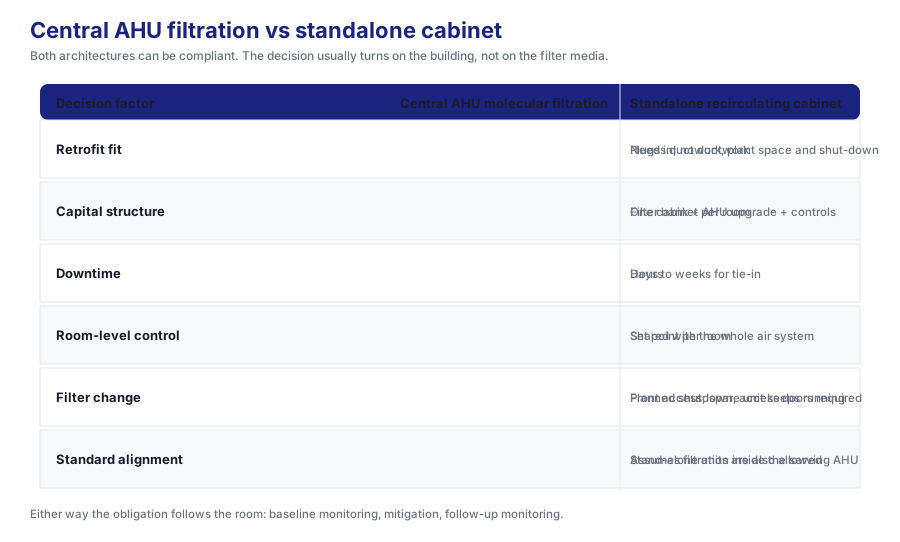
5. Selection Matrix: Central AHU vs Standalone Cabinet
| Criterion | Central AHU + molecular filter bank | Standalone recirculating cabinet |
|---|---|---|
| Retrofit fit | New build, major refurbishment, or an existing AHU with plant space, roof or riser available and a shutdown window to use | Listed buildings, basements, leased floors and occupied rooms with no ducting route; split or VRF systems; one problem room |
| Capital structure | Concentrated: plant, ductwork, controls, filter housing, access platforms, commissioning. One AHU zone is the smallest sensible project, so it is hard to justify for a single room | Distributed: one cabinet per room, plus electrical points, floor area and commissioning. Can be phased room by room, starting with the highest-value store |
| Downtime | Days to weeks: tie-in, structural penetrations, fire-stopping, balancing — a construction project before it is an air-quality project | Hours: a fit-out item. But a filter change happens inside the room, so plan the access and the outage window |
| Room-level control | One filter bank protects every space on the circuit; the store cannot be treated alone, and humidity control must be designed into the same AHU | A per-room set point held by the unit itself, with unit-level sensors and room-level accountability; no make-up air and no pressurization |
| Filter change | One bank, one change event, serviced from the plant room while the room stays live; detectors must be accessible upstream and downstream | One filter set per unit, changed at the unit inside the room; the count scales with the number of rooms |
| Standard alignment | The architecture NARA 1571.4 h is written around: return and make-up air, gas-phase stage ahead of the final particulate filter, MERV 14 or greater | Also addressed: dedicated systems serving holdings rooms may be stand-alone units or fully integrated systems, so the room-level route is a compliant one, with the monitoring obligation unchanged |
6. Cost Structure: What the Money Actually Buys
Neither standard prescribes a cost model, and the options do not compare on equipment price because they buy different things. The entries below are cost drivers to price on your own bill of quantities, not benchmark figures.
| Cost element | Central AHU + gas-phase filter bank | Standalone cabinet |
|---|---|---|
| Project scope | Plant, ductwork, controls, filter housing, commissioning | Units, electrical points, floor area, commissioning |
| Smallest sensible project | One AHU zone; hard to justify for a single room | One room; can be phased room by room |
| Change to the building fabric | Structural penetrations, risers, plant access | Little to none; no ductwork |
| Filter material | One larger bank, serviced from the plant room | One filter set per unit, serviced in the room |
| Program risk | Long-lead plant, builder’s work, weather-tight penetrations | Short, staged, largely fit-out |
| Hidden retrofit cost | Access, fire-stopping and builders’ work in occupied areas | Floor area, power, noise and local heat load in the store or reading room |
The deciding question is rarely the equipment line: it is whether the building can accept a ductwork route at all, and if it can, whether one plant-room filter bank is worth the disruption compared with a phased cabinet program starting with the highest-value store.
7. The Standards Gap You Must Design Around
ISO 10121-3:2022, Test methods for assessing the performance of gas-phase air cleaning media and devices for general ventilation — Part 3: Classification system for GPACDs applied to treatment of outdoor air (published October 2022), classifies gas-phase air cleaning devices on single-pass outdoor air using four reference pollutants — ozone, sulfur dioxide, nitrogen dioxide and toluene — and three duty levels per pollutant. Its scope then states that the document does not apply to GPACDs in recirculation applications and/or dealing with pollution from indoor sources.
A recirculating cabinet is both. An ISO 10121-3 classification therefore cannot be claimed for in-room recirculating performance — if a supplier offers one as proof, the claim is out of scope. Its absence is not a failure: the standard simply does not describe the application. And you must assemble the proof yourself, in three layers — supplier data for media and unit under declared conditions, independent third-party verification, and room-level evidence measured against NARA 1571 Supplement 2 Table 2.
Watch the method and the level it was applied at. Media testing is covered by ISO 10121-1:2014 or ANSI/ASHRAE 145.1; device testing by ISO 10121-2:2013 or ANSI/ASHRAE 145.2. Confirm current editions — the 145.1 addendum approved on 28 February 2023 harmonized its definitions with 145.2 and with the ASHRAE Handbook—Applications Chapter 47, “Air Cleaners for Gaseous Contaminants.” And remember that “tested per ASHRAE 145.x” is a laboratory rating, not a certification: ASHRAE states that compliance is voluntary, that it does not certify or guarantee product performance, and that no product may claim ASHRAE approval.
Then check the accreditation chain, not the logo. In China, CMA is a mandatory scheme: a body may issue data with probative effect only within the capability scope on its certificate, must apply the CMA symbol, and certificates are valid for six years — and because authorities publish licensed bodies and certificate status, that status is publicly verifiable. CNAS, the national accreditation body, accredits to ISO/IEC 17025 among other criteria and is a signatory to the IAF, ILAC, APLAC and PAC mutual recognition arrangements. Accreditation is activity- and method-specific, not a blanket endorsement: the specific test method must sit inside the accredited scope, and any result outside it needs an explicit disclaimer.
Corrosion monitoring is the practical surrogate for the third layer, framed by AAF’s classification table built on ISA S71.04 methodology using 30-day silver and copper film growth: S1 <40 Å / C1 <90 Å is described as “Extremely Pure — Ideal air quality for archival environments, metal collections, and rare books”; S2 <100 Å / C2 <150 Å as “Pure”; S3 <200 Å / C3 <250 Å as “Clean”; and S4 <300 Å / C4 <350 Å as “Slightly Contaminated.” Treat it as a vendor table, not a consensus standard, but it gives you a monitoring unit that is cheap to deploy and comparable over time.
8. What to Ask a Supplier, and How to Verify It
Ask for these in writing, and refuse verbal substitutions. The first six apply to either architecture:
- Pollutant targets, with units — for example NARA 1571 Supplement 2 Table 2 (SO2 5 µg/m³, NO2 5 µg/m³, O3 5 µg/m³, acetic acid 250 µg/m³), plus the tighter microclimate limits if cases are involved.
- Filtration configuration against those targets: the particulate stage and the standard it is rated against (MERV 14 or greater per ASHRAE 52.2 in NARA terms), the gas-phase media type, and its position relative to the final particulate filter.
- Gas-phase test evidence for media and complete unit, with removal efficiency against a named challenge gas at a stated concentration, face velocity, residence time, temperature and relative humidity, plus time to breakthrough. Without those parameters the percentage carries no meaning. Ask whether the test is single-pass outdoor air or recirculating in-room: if the answer is ISO 10121-3, it is single-pass outdoor air and out of scope for recirculation and indoor sources.
- Who tested, under what accreditation — CMA symbol and certificate number, or ISO/IEC 17025 accreditation with CNAS/ILAC MRA coverage. The report must state its technical basis, be sealed, and be signed by an authorized signatory within that person’s competence; any subcontracted item must be named and previously agreed.
- The monitoring plan: upstream and downstream access where filters are installed, baseline passive-monitor testing in the room, and follow-up monitoring after corrective action — the sequence NARA 1571.4 g.1 describes.
- Filter service data: change-out criteria and how they are measured (pressure drop or equivalent for the particulate stage), the stated service life of the gas-phase media and its basis, access requirements and the disposal route.
For a standalone cabinet specifically, add: declared capacity per unit (dehumidification kg/24 h, humidification kg/h, purification efficiency, rated room area) with the conditions those figures were obtained at; the quality of humidity control, including water source treatment and the fail-safe that stops humidification before RH exceeds the target band; the protocol and register list for the BMS link, so room data lands in your monitoring record rather than a vendor portal; noise, heat load into the room and electrical supply per unit; what is needed to relocate a unit without re-commissioning the building; and, for a CE-marked unit, the directives and standards covered and whether the gas-phase performance claim sits inside that scope.
One terminology check while you are at it. Require the specification to name the technology correctly: gas-phase filtration, molecular filtration, acid-gas removal, corrosion control. “Deacidification” is a conservation treatment applied to acidic paper and books by adding alkaline compounds; it is not a term for air-side equipment, and a tender that asks for it is asking for the wrong thing.
9. Where This Leaves a Retrofit
The central-AHU route remains the reference architecture: NARA 1571 is written around it, it filters return and make-up air, and one filter bank with one service point scales to a whole zone. A standalone cabinet does not replace it where ductwork and plant space exist. What the cabinet offers is a boundary condition the standards describe poorly — an existing storage room that will never get an AHU. Its cost structure is phased rather than monolithic, its construction impact is fit-out rather than building work, it gives room-level control and accountability, it moves when the store moves, and its filter service happens where the collection is.
Its price is the evidence burden. Because ISO 10121-3:2022 excludes recirculation and indoor sources, the performance case must be built from unit data, independently accredited test evidence and room-level measurements against the NARA 1571 thresholds. Budget for that work at specification stage, not after handover — it is the difference between a room that is compliant and a room that merely has a cabinet in it.
Specifying Filtration for a Room You Cannot Re-Duct
The CJS-HP100B is a standalone in-room cabinet combining dehumidification, humidification and gas-phase plus particulate purification: 70–100 kg/24 h dehumidification, 6–8 kg/h humidification, 99.90% purification efficiency, 80–100 m² coverage, a 10-inch touchscreen interface, RS485/Modbus for BMS integration and CE marking. Capacities are supplier-published, and the unit does not replace make-up air, pressurization or a central plant.
View CJS-HP100B Specifications →Visit our online store for pricing →
Questions? alex@syprointl.com | +86 177 1055 7225
By environment: Archive & vault · Museum storage · Library special collections · Film & AV archive